

NEWS

BACK TO LIST
Youth rustication and its long-term impact on nonmaterial well-being
- Date 2017-08-01 09:30
- CategoryResearch and Education
- Hit3235
A brief introduction to the recent paper: Wang, Shun and Weina Zhou (2017). The Unintended Long-Term Consequences of Mao’s Mass Send-Down Movement: Marriage, Social Network, and Happiness, World Development, 90, 344-359.
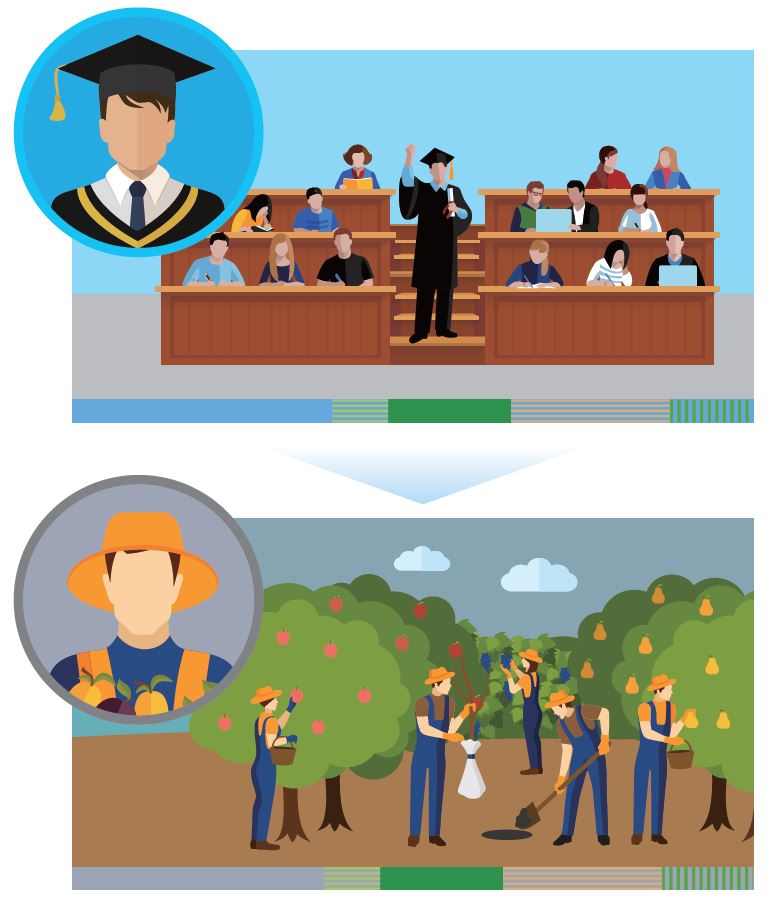
The send-down movement during China’s Cultural Revolution forced more than 16 million adolescents (most 16-19 years of age) to move away from their families to the countryside to live and work with peasants in poverty and under harsh political/mobility control (1968-1978). These rusticated youth stayed in the countryside from one to as many as 10 years. Most managed to move back to urban areas after the central government ended the movement in 1978. Life in the countryside was obviously a big challenge to the rusticated youth, as evidenced by some sociologists who have personal experience: “To many urban youth, including us, the send-down episode remains among the most difficult experiences in our lives—we suffered from removal from our families, an unfamiliar environment, harsh physical labor, and so on”.
Though the life in poor rural areas was extremely hard for the rusticated youth, some recent studies indicate that this negative life event may have no long-term negative impact and may even have some positive economic consequences. One study finds a higher proportion of rusticated youth entering college and the workforce as cadres in government, both groups enjoying high social status in China. Other studies find that the send-down years had a positive effect on income. The reason might be because, upon return, those send-downs were more motivated to strive for better performance, similar to returning refugees induced by conflicts to simply try harder.
Despite the evidence of rustication’s positive impacts in a few measures of material well-being, whether there is a long-term effect on individuals’ nonmaterial well-being is relatively unknown. Because material well-being indicators might not be enough to fully represent the quality of life, it is desirable to examine the send-down effect on nonmaterial well-being. To fill in the literature gap, we thus study three important and correlated groups of nonmaterial well-being measures: marriage outcome, social network, and self-reported happiness. However, due to data limitations, we are not able to study other non-material well-being indicators such as physical or mental condition.
We primarily use the China General Social Survey (CGSS) 2003 for our study. We utilize a detailed set of variables of parents’ characteristics when respondents were 18 years old in the CGSS data to compare sent-down individuals to non-sent-down individuals who shared similar characteristics, such as birth cohort, education level, and family background during the send-down movement.
When the send-downs returned to urban areas, they already averaged more than 22 years old. While most young men and women in urban areas had already started searching for spouses at this age, because marriage was almost mandatory in China in the 1980s, the sent-down youth had just returned to urban areas or were struggling to adjust to their life after returning. Were send-downs able to find a quality match under their time and financial constraints, given the assortative mating in the marriage market? We find that both female and male send-downs married 1.2 years later than non-send-downs. In addition, despite the fact that 99% of respondents did marry, the proportion of send-downs still married in 2003 was much lower than that of the non-send-downs. Their late entry into the marriage market may have hampered send-downs in finding a high quality match. We further find evidence suggesting lower quality matches for the send-downs: compared to their non-sent-down counterparts, they are more likely to “marry down” in terms of family wealth, their spouses are less likely to communicate troubles and stress to them, and their spouses are also less likely to do housework.
Given the fact that the send-downs were forced to separate from their families and original social networks for an average of 5 to 6 years during adolescence, we know little about how such separation could affect the long-term formation of those individuals’ social networks. As we learn that social connections decline sharply with physical distance, we suspect the forced separation would impact the send-downs’ social network negatively. Using self-reported estimates of the intimacy of their relationships with relatives and friends as a measure of the density of the social network, we find that the send-down experience had a negative impact on the density of their later social networks. Evidence suggests that the send-down experience also reduced the size of their social network: the sent-down individuals greeted fewer relatives during the Spring Festival, one of the most important periods for family gatherings in China.
We also analyze the long-term consequences of the send-down experience on individuals’ happiness. The harsh manual labor experience in rural areas was extremely difficult for the sent-down youth who were, on average, only 17 years old and most likely had never been in rural areas prior to being sent down. However, decades after they returned to urban areas, did the send-downs overcome the transition and become as happy as their non-sent-down counterparts or even happier, parallel with the pattern of their material well-being? In contrast to the literature, which supports a positive effect of the send-down experience on material well-being, we find a negative effect on happiness.
In summary, our study adds to the growing literature that seeks to evaluate the impact of forced migration. Contrary to many studies on the send-down movement showing positive impacts on youths’ educational attainment and income, we find a significantly negative effect on individuals’ nonmaterial well-being, measured by marriage outcome, social network, and happiness. Those who had been sent down had more delayed marriages, were more likely to have lower quality of family life, had smaller size of social network and less intimate relationships with friends and relatives, and reported lower happiness scores. Our study provides an example of how difficulties that individuals experienced during adolescence may leave a long-lasting impact on their well-being.
Our study suggests that, besides considering the commonly used indicators related to employment, consumption, income, and wealth, the nonmaterial aspects of life should not be ignored when evaluating the effect of forced migration. These results from the send-down experience may also remind policymakers engaging in tragedy relief that the end of a disaster is unlikely to be the end of the story. Instead, the difficulties experienced in the past may continue to affect people’s lives for a very long period through various channels. Thus, policymakers should consider designing measures to mitigate both short-term and long-term negative impacts.
By Professor Shun WANG, KDI School
TAG
#Research
Related News
-
Research and Education 2026-09-03
Republic of Korea Economic Bulletin, September 2026#KDI #Economic #KDISCHOOL #kdischool #Economic Bulletin #Research
-
Research and Education 2026-08-04
Republic of Korea Economic Bulletin, August 2026#KDI #Economic #KDISCHOOL #kdischool #Economic Bulletin #Research
-

Research and Education 2026-07-06
Republic of Korea Economic Bulletin, July 2026#KDI #Economic #KDISCHOOL #kdischool #Economic Bulletin #Research