

NEWS

BACK TO LIST
Sustainable development for a progressive future: interview with ambassador Oh Joon
- Date 2017-12-01 08:10
- CategoryResearch and Education
- Hit2998

When it comes to addressing sustainable development on the international stage, look no further than the former President of the United Nations Economic and Social Council (ECOSOC), His Excellency, Ambassador OH Joon. Better known as Professor Joon, the former Ambassador teaches “The United Nations and Sustainable Development,” a desired course for many at KDI School.
Selected as South Korea’s Permanent Representative to the United Nations in 2013, Professor Joon was also subsequently appointed as the President of the Economic and Social Council (ECOSOC) for a one year term, starting July 24, 2015 while simultaneously serving as the President of the Conference of States Parties to the Convention on the Rights of Persons with Disabilities (CRPD). He also served as President of the Security Council for May 2014 during the 2013-2014 term. Prior to this position, he was Ambassador of the Republic of Korea in Singapore from 2010 to 2013 and Deputy Minister for Multilateral and Global Affairs in the Ministry of Foreign Affairs and Trade in Seoul from 2008 to 2010.
Speaking to The Globe, Professor Joon said “development” constitutes one of the three pillars of the United Nations, as embodied in its Charter of 1945.
“The founders of the UN were wise and visionary in that they acknowledged the importance of development and human rights in maintaining peace and security, thus establishing the three pillars. The concept of development has evolved over the years. The initial focus on economic growth has expanded to incorporate the social and environmental dimensions, important landmarks of which having been the introduction of the concept of “human development” in 1990 and the adoption of the ‘Sustainable Development Goals (SDGs)’ in 2015.”
“The UN adopted 17 goals for sustainable development. SDGs are different from Millennium Development Goals (MDGs) in that they are very comprehensive. These 17 goals cover all areas of human activity. If you are studying human development, you are basically studying all human activities. It’s not just about studying SDGs. We are studying humanities and efforts to improve our lives,” he said.
According to Professor Joon, the course has also been designed to introduce students to the United Nations’ efforts in the area of development to “promote conditions of economic and social progress and development” as provided in Chapter 9 of the UN Charter.
When asked about the important role KDI School has been playing in the lives of the many students who have roamed its campus in the last 20 years, Professor Joon said Korea had a unique experience in developing itself, particularly when it is among only a handful of countries that transformed itself from a least developed country, to a leading developing country and now a developed country.
“We did it virtually within one generation so that could be a good model for other developing countries. But I don’t think all of Korea’s experiences can be models.”
“Some experiences may be unique to Korea but not applicable to other countries so the efforts to study the case of Korea for development should focus on finding out which part of Korea’s experience can be applied to other developing countries as well,” he said.
He added that like most other course offered at KDI School, students must focus on how development is being pursued at the international level saying Korea’s case will not be helpful to other countries if it is not viewed at the level of global development efforts. “Korea is just part of the world. If we alienate Korea’s case from this overall context, then the meaning of Korea’s experience is not much.”
As KDI School celebrates its 20th anniversary this year, Professor Joon said development is an ongoing process and Korea is no different. “10 years from now, we will still be struggling or tackling the same issues which we are doing now. At the global level, what kind of development are we trying to achieve for the future of humanity? And how do we make it sustainable?”
“Here at KDIS, we will be trying to figure out the case of Korea and how it is relevant to the overall developmental efforts at the international level and how we can serve as a model for other developing countries. Both Korea’s successes and failures can be lessons for other countries,” he added.
By Rosa DALITUICAMA (2017 MDP, Fiji)
TAG
#Interview
#Research
Related News
-
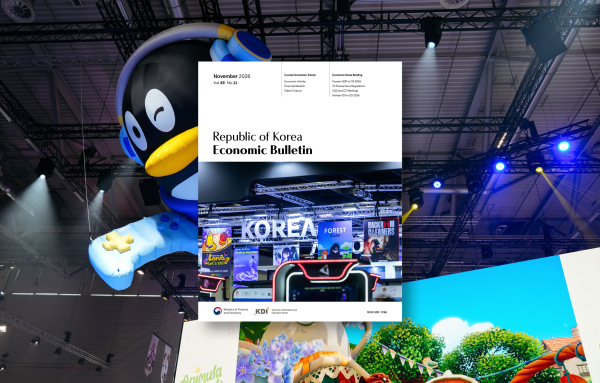
Research and Education 2026-11-04
Republic of Korea Economic Bulletin, November 2026#KDI #Economic #KDISCHOOL #kdischool #Economic Bulletin #Research
-
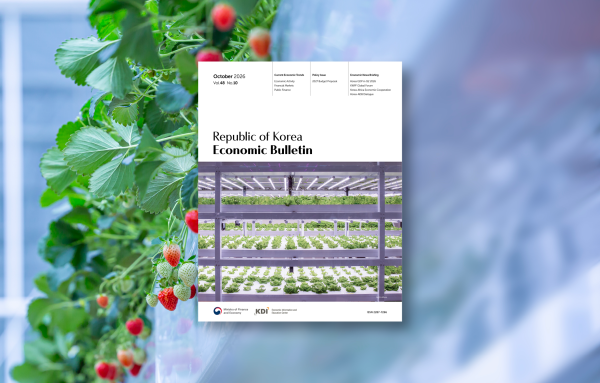
Research and Education 2026-10-13
Republic of Korea Economic Bulletin, October 2026#KDI #Economic #KDISCHOOL #kdischool #Economic Bulletin #Research
-
Research and Education 2026-09-03
Republic of Korea Economic Bulletin, September 2026#KDI #Economic #KDISCHOOL #kdischool #Economic Bulletin #Research